
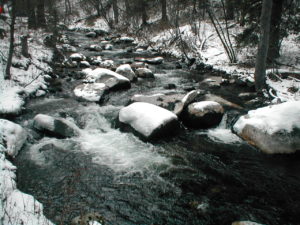
 As warmer temperatures begin to thaw winter’s blanket of snow and ice, the runoff enters lakes, rivers and streams, carrying with it a winter’s-worth of de-icing compounds.
Despite making roads safer, salt and deicers are still peppered with danger. Between 10 and 20 million tons of salt are applied to roadways every year. These liberally-applied agents are linked to a diverse array of environmental ills, from aquatic “dead zones” and salt-damaged plants, to poisoned amphibians, and possibly even increased cancer risk in humans.
Besides the impacts of increased salinity, unrefined road salt can contain impurities that aren’t found in its tabletop cousin. It can contain various metals and minerals, and often chemical additives like sodium ferrocyanide, an anti-caking agent. And even pure salt isn’t exactly eco-friendly, since it raises the salinity of local water supplies, potentially making them toxic to native fish and wildlife.
Common chemicals used to de-ice roads are
- Road Salt or Rock Salt (NaCl)
- Potassium Chloride (KCl)
- Magnesium Chloride (MgCl2)
- Calcium Chloride (CaCl2)
- CMA- Calcium Magnesium Acetate
- PotassiumAcetate (CH3CO2K)
- Urea (CH4N2O) and
- Sand
Read this article by the Cary Institute titled, “U.S. Rivers and Streams are Compromised by Increasing Salt Loads” http://www.caryinstitute.org/newsroom/us-rivers-and-streams-are-compromised-increasing-salt-loads


